Dhoti vs Veshti: What's the Difference?
If you've ever been confused about whether to say "dhoti" or "veshti," you're not alone. The two terms get used interchangeably in casual conversation, wedding invitations, and online stores. But there are real differences — in the regions where each is traditionally worn, how they're draped, and the occasions they're associated with.
Here's a clear, practical guide to sorting them out.
The Short Answer
"Dhoti" is the general, pan-Indian Hindi/Sanskrit term for the traditional men's lower garment. It's used across North, East, and parts of West India, and is understood almost everywhere.
"Veshti" (வேட்டி) is the Tamil word for essentially the same garment, but with regional variations in style and draping. In Tamil Nadu and Tamil-speaking diaspora communities, "veshti" is the preferred term.
In casual conversation, a veshti is a dhoti. But when someone specifies "veshti," they're usually signaling a South Indian — specifically Tamil — style of the garment.
Regional and Linguistic Origins
- Dhoti: Derived from Sanskrit and used across North India, East India (West Bengal, Odisha), and parts of Maharashtra and Gujarat. Related names include "dhuti" (Bengali) and "dhotra" (Marathi).
- Veshti: Tamil term, used in Tamil Nadu, Sri Lanka's Tamil community, and Tamil diaspora populations.
- Mundu: Malayalam term used in Kerala — similar garment but with distinct Kerala styling, typically plain white or cream with a thin gold or colored border.
- Panche or Pancha: Kannada and Telugu terms for a similar garment.
All of these refer to roughly the same category of unstitched rectangular cloth worn around the waist and legs. The differences show up in how they're worn, what occasions they're worn for, and the specific weaves that are traditional to each region.
Length and Width Differences
North Indian Dhoti: Typically 4 to 5 meters long, 1.2 to 1.5 meters wide. Can be cotton, silk, or a blend.
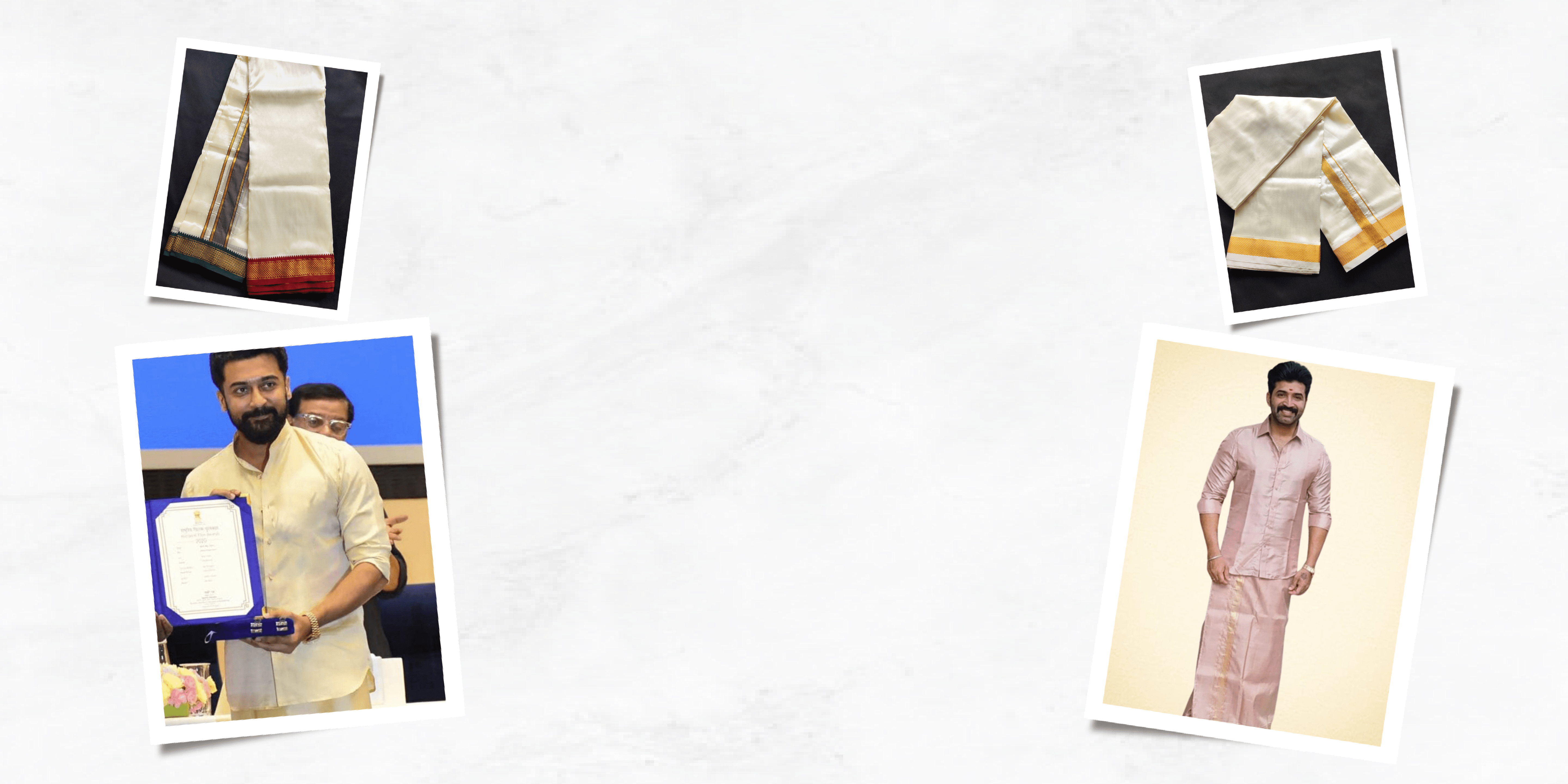
Tamil Veshti: Usually 3.5 to 4 meters in a single piece, often sold as a matched 4-meter + 2-meter set (the 2-meter piece is the angavastram, the matching shoulder drape). Traditional veshtis come in pure white or cream with colored or gold borders.
Kerala Mundu: Shorter, typically 2 to 2.5 meters in a single piece. Worn folded double for formal occasions. The kasavu (gold zari) border is iconic.
Draping Styles
This is where the differences become most visible:
North Indian Dhoti (Bengali or Maharashtrian style): Often tied with deep pleats in the center-front, with the back-pleats tucked between the legs (panchakacham style). The draping is more voluminous and pant-like.
Tamil Veshti: Two common styles — mundhaanai style (simpler wrap tied at the waist, no between-the-legs tuck) and panchakacham (tucked between the legs for religious ceremonies and weddings). Tamil Brahmin weddings and temple ceremonies specifically require the panchakacham drape.
Kerala Mundu: Worn folded double — a neat, shorter drape that sits just below the knee or at the ankle. No tucking between the legs. The fold is secured at the waist with a simple knot.
Occasions Each Is Worn For
Dhoti: Common across North India for weddings, pujas, Diwali, Holi, and cultural events. In West Bengal, the dhoti is essential for Durga Puja and family functions.
Veshti: Tamil weddings, Pongal, Tamil New Year, classical music concerts, and temple visits. Silk veshtis in cream with gold or maroon borders are standard for weddings.
Mundu: Kerala weddings (both Hindu and Christian), Onam, Vishu, temple ceremonies, and cultural events. The plain white mundu with a thin gold border is the Kerala signature look.
Fabric Choices
Both dhotis and veshtis are available in similar fabric options:
- Cotton: Everyday wear, comfortable in warm weather, pocket-friendly
- Pure silk (Kancheepuram, Arani): Formal weddings, major ceremonies
- Silk cotton blend: Semi-formal events where full silk would be too heavy
- Art silk: Affordable alternative to pure silk, good for occasional wear
The fabric choice depends on occasion more than regional preference. A Tamil wedding and a Bengali wedding both call for silk — they just drape it differently.
Which One Should You Buy?
If you're shopping for a specific event, the answer is usually dictated by the community hosting the event:
- Tamil wedding or cultural event: Buy a veshti with the matching angavastram (shoulder drape). Learn the panchakacham drape if it's a traditional ceremony.
- Kerala wedding or Onam: A plain white mundu with gold border is the standard.
- Bengali or North Indian wedding: A dhoti in cream, white, or matching color with the family theme. Learn the regional drape for the community.
- General festive wear: Any of these work. The term "dhoti" is broad enough that a shop labeled "dhoti set" usually stocks varieties of all three.
Common Misunderstandings
"Are they the same thing?" Functionally yes, linguistically and stylistically no. The garment category is the same, but the regional styling differs.
"Can I wear a North Indian dhoti to a Tamil wedding?" Technically yes, but if you want to show cultural respect for the hosts, a veshti in the Tamil style is appropriate.
"Is a mundu a kind of veshti?" They're cousins. Both are South Indian, both are unstitched lower garments, but the Kerala mundu is shorter and draped differently.
Where to Buy Each
Finding authentic regional styles in the USA can be tricky. Many generic "dhoti" sellers stock only one style, which doesn't work if the occasion is specifically Tamil, Kerala, or Bengali.
We stock a curated collection of dhotis and veshtis covering Tamil, North Indian, and Kerala styles — all shipping from our Milpitas, CA warehouse in 3–5 days. Whether you need a cream silk veshti with a gold border for a Tamil wedding or a Kerala mundu for Onam, we can help you find the right piece.
Browse our complete men's ethnic wear collection for kurta sets, angavastrams, and accessories to complete the look.

Written by JCS Fashions