What Makes Patola Sarees Special? A Guide to Double Ikat Weaving
Patola sarees have a reputation that precedes them — and rightly so. They're among the most labor-intensive handwoven sarees in India, often taking six months to a year to complete a single piece. The weaving technique, called double ikat, is practiced by only a handful of families worldwide. And an authentic Patola can cost anywhere from a few hundred dollars to tens of thousands.
Here's a complete guide to what makes Patola sarees special, how the weaving actually works, how to spot an authentic piece, and whether one belongs in your wardrobe.
The Origin of Patola
Patola sarees originate from Patan, a town in Gujarat in western India. The weaving tradition dates back roughly 900 years, and was historically reserved for royalty and wealthy merchant families. Today, the craft is kept alive by a small number of weaver families — primarily the Salvi family in Patan — who pass the technique down through generations.
A single authentic Patan Patola saree typically takes 4 to 6 months to weave, and intricate bridal pieces can take more than a year. That's not an exaggeration — it's the time needed to hand-dye every thread according to the final pattern, then align them on the loom.
What Is Double Ikat Weaving?
Ikat is a resist-dyeing technique where yarn is tied and dyed before weaving. The pattern emerges from the dyed threads themselves, not from printing or embroidery applied afterward.
There are three ikat variations:
- Single ikat: Only the warp or the weft threads are tied and dyed. Common in Pochampally and Orissa.
- Combined ikat: Both warp and weft use ikat, but dyed separately and combined loosely.
- Double ikat: Both warp and weft threads are tied and dyed individually to match. When woven, they align to form a precise pattern.
Patola uses double ikat — the hardest version to execute. The weaver must align two pre-dyed thread sets so precisely that the pattern emerges without distortion. There's essentially zero margin for error; a 1mm shift compounds across meters of fabric.
Patan Patola vs. Rajkot Patola
Not all sarees labeled "Patola" are equal. Two main types exist:
Patan Patola (double ikat): The traditional, fully handwoven version from Patan. Uses pure silk, natural dyes, and true double ikat technique. Prices start around $1,500 and can reach $20,000+. Incredibly rare.
Rajkot Patola (single ikat): Made in Rajkot, Gujarat. Uses single ikat, which is much faster and cheaper to produce. Prices range from $100 to $500. Still beautiful and handwoven, but not the same craft level as Patan Patola.
Most "Patola" sarees sold commercially are Rajkot Patola or Patola-print (machine printed to look like Patola). True Patan Patola is niche.
Traditional Patola Motifs
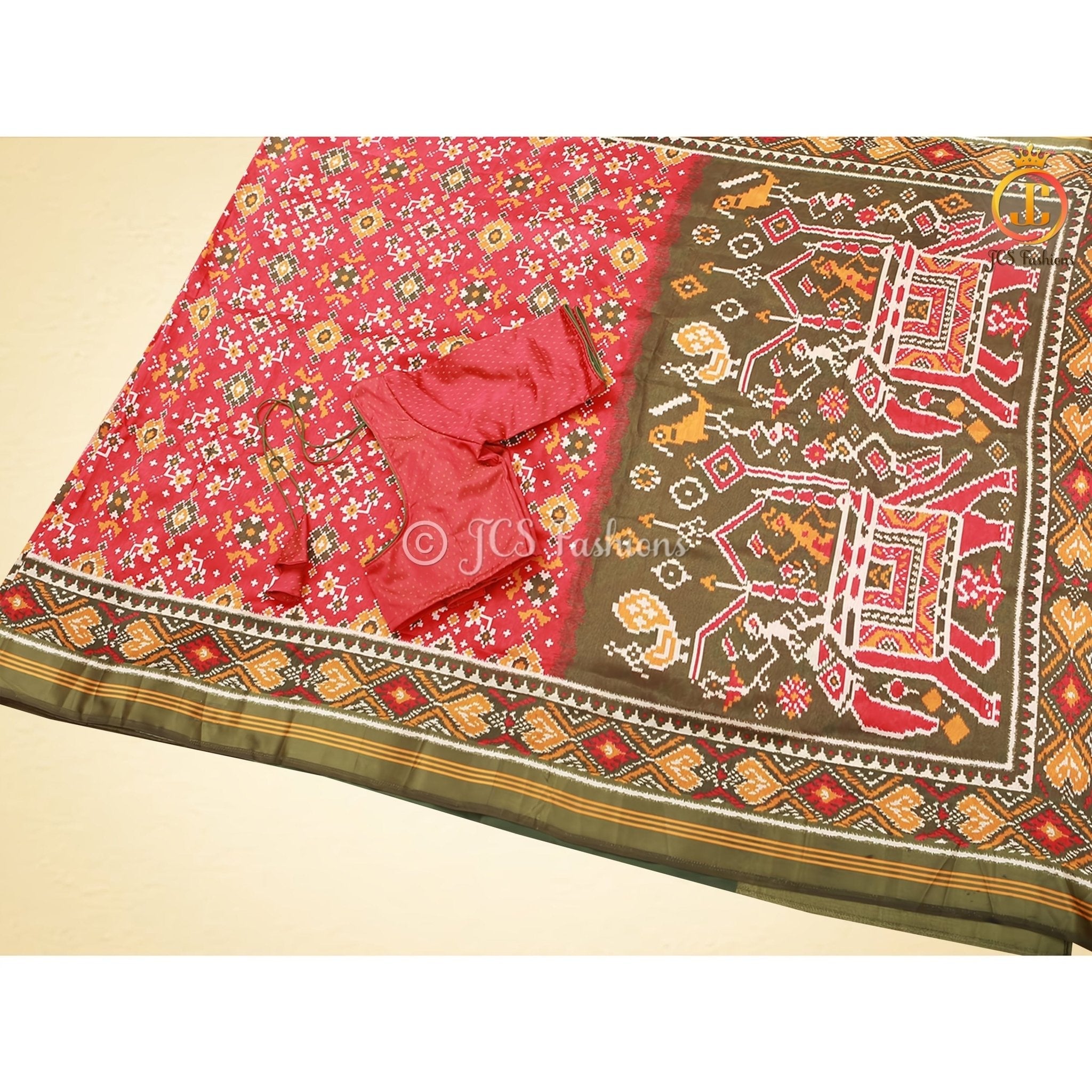
Traditional Patola designs are heavily symbolic and drawn from Gujarati mythology and court culture. Common motifs include:
- Narikunj: A design featuring women, birds, and elephants arranged in a grid. Considered royal.
- Navratna Bhat: Nine-jewel pattern — geometric circles arranged in a 3x3 grid, each representing a gemstone.
- Pan Bhat: Leaf-based pattern, often used for bridal Patolas.
- Phulwadi: Floral vine pattern.
- Chabdi Bhat: Basket-weave geometric design.
- Ratan Chowk: Diamond-based court motif.
Colors are typically deep and saturated — rich reds, royal blues, mustards, emerald greens, and pitch blacks — often in contrasting combinations.
How to Identify an Authentic Patola
Check both sides. In a true double ikat, the pattern looks identical on both sides of the fabric — this is the signature test. Machine-printed "Patola" will have a faded or blurry reverse side.
Look for slight imperfections. Authentic Patan Patola has tiny, intentional irregularities where the dyed threads shift slightly during weaving. Perfect symmetry often means printed, not woven.
Ask about the weaver. A seller who can name the family, workshop, or region should be able to describe the process in detail. Vague answers are a red flag.
GI (Geographical Indication) tag. Authentic Patan Patola has a GI certification. Not every authentic piece carries the tag (it costs extra for weavers to register), but its presence is a strong signal.
Weight and hand-feel. Pure silk Patola has a specific weight and drape. If the fabric feels too light or too synthetic, it's probably polyester.
When to Wear a Patola
Patola sarees are meant for occasions. They're not daily wear pieces.
- Weddings (as a bride or close family): Bridal Patolas are traditional in Gujarati weddings.
- Receptions and high-formality events: A Patola makes a statement without being gaudy.
- Religious and cultural festivals: Navratri, Diwali, major puja events.
- Heirloom occasions: Passing down a Patola is a tradition in Gujarati families. If you own one, it's worth wearing for moments that will become family memories.
A Rajkot Patola is more flexible — it can work at a Sangeet, a festive dinner, or a cultural event without feeling overdressed.
Styling a Patola Saree
The saree is the statement. Keep everything else simple:
- Blouse: Solid color in one of the saree's accent tones. Avoid heavy embroidery that competes with the weave.
- Jewelry: Gold or temple jewelry. Kundan and polki work beautifully. Skip diamonds — they feel out of place against the deep dye colors.
- Hair: Traditional styles — low bun with gajra, or braid with flowers. Modern updos can clash with the traditional aesthetic.
- Footwear: Kolhapuris, juttis, or block heels in gold or cream.
Caring for a Patola
- Dry clean only. Water can cause the natural dyes to bleed.
- Store rolled in cotton muslin. Folding creates permanent creases on silk.
- Rotate annually. Take it out once a year to air, even if not wearing.
- Keep away from direct sunlight. UV fades natural dyes.
- No perfume or hairspray. Apply fragrance before draping, never on the saree.
A well-cared-for Patola can last 100+ years. Many families have pieces passed down through three or four generations.
Is a Patola Worth the Investment?
For most buyers, the answer depends on what you're buying it for:
- Daily festive wear: A Rajkot Patola ($100–400) offers the look without the commitment.
- Wedding wardrobe or heirloom piece: A true Patan Patola is a lifetime investment. If budget allows, it's one of the few sarees that actually appreciates over time.
- Just exploring the style: Start with a Patola-inspired print or a Rajkot version. Learn what you like before investing in a Patan piece.
Where to Buy
Authentic Patolas are difficult to find in the USA. Most online sellers stock Rajkot Patolas or Patola-print sarees — both legitimate options at their price points, but not the same as Patan Patola.
We stock a curated Patola saree collection — each piece labeled by type (Rajkot single ikat, Patan double ikat, or Patola-print) so you know exactly what you're buying. Every saree ships from our Milpitas, CA warehouse in 3–5 days, no customs delays.
For a broader view of handwoven traditional sarees, browse our full saree collection.

Written by JCS Fashions